AI continues to offer significant benefits for supply chain operations everywhere. In fact, AI earned the number-one spot on ASCM’s Top 10 Supply Chain Trends in 2025, spotlighting advances happening at an unprecedented rate and offering many immediate advantages. This transformative technology is reshaping how goods move, data flows and decisions are made, fundamentally changing the landscape for supply chain professionals. As AI adoption accelerates, understanding its capabilities, limitations, nuances and future trajectory is crucial for leading future-ready, resilient and responsive networks.
What is AI in supply chain?
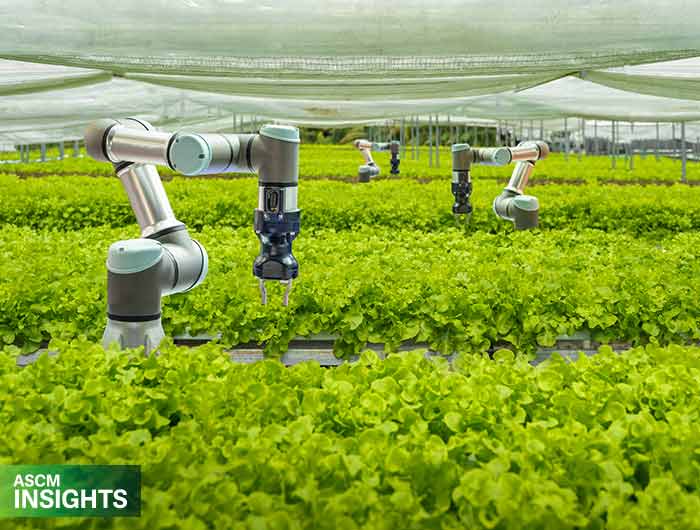
AI in supply chain refers to computer programs trained to perform complex actions that typically require human intelligence, such as understanding language, analyzing data, making recommendations or creating new content. Specific to supply chain, this includes optimizing inventory and delivery routes, predicting demand, automating warehouse operations with robots and drones, evaluating suppliers, and enhancing risk assessment across global networks. AI also powers tools such as augmented reality, digital twins and process automation, even handling tedious jobs such as cycle counting.
To simplify what you need to know to use AI successfully, here are six key points.
1.) There’s no need to fear: AI has existed — and we’ve been using it — for a long time. The concept of AI has been around for more than 70 years, since Alan Turing published "Computing Machinery and Intelligence" in 1950, which ultimately set the stage for AI. In the 1960s, MIT developed Eliza, an early ancestor of today’s chatbots commonly used for online customer service. Other types of AI were developed to be very good at a specific task, such as winning at chess or “Jeopardy!” This is the kind of AI that is most commonly integrated into supply chain and manufacturing environments to automate a specific, repetitive task and free humans to do more complex work.
2.) AI is not going to take your supply chain job — but will likely change it. Yes, some jobs will become obsolete with AI use increasing, but new jobs will appear in support of AI tools. In fact, 50% of surveyed companies expect new jobs to be created as a result of their adoption of AI. Most of these will be higher paying, safer and more fulfilling. It’s seeming more and more evident that the supply chain professionals who need to worry are those who do not embrace AI.

3.) AI requirements. It’s crucial to figure out how AI makes the most sense for your company or operation. Build a portfolio of use cases that show how it will benefit your supply chain, especially in areas such as route optimization, sales forecasting, product categorization, safety stock calculations, supplier management and warehouse management. Also consider future uses. Then, take a careful look at the expected return on investment from each implementation option, and prioritize your AI implementation goals based on that.
4.) AI relies on massive amounts of good data. This data can come from an enterprise resource planning system, a warehouse management system, financial records, business directors, weather data and more. But whatever data you use, ensure it is relevant, accessible, accurate, complete, up-to-date and reliable. One approach is to focus on gathering a smaller amount of quality, relevant data to start and then enrich the pool as new data becomes available.
5.) There’s plenty that AI still isn’t good at. AI is still learning and developing — not unlike humans. The technology is prone to hallucinations (generating content that has factual or reasoning errors). Therefore, humans need to review outputs before acting on them. If companies fail to do this step, they could face significant financial and operational consequences. It may be best to limit AI use to back-office activities at first until you feel confident your tool can be a reliable asset. Then, you can move forward with customer-facing interactions, strategic decision-making or even autonomous operational control — within well-defined parameters.
6.) People are the real power behind AI. The human touch is an essential element of successful use of AI, yet a skills gap still exists. The best and most cost-effective strategy is to upskill yourself and your team. Take the first step with ASCM’s Technology Certificate. This industry-leading program delves deep into the world of AI, as well as advanced analytics, cybersecurity, additive manufacturing and much more to help you stay well ahead of the curve.
The future of AI in supply chain
In the years to come, AI is likely to enable increasingly autonomous, predictive and interconnected networks. It will move beyond specific task automation to drive end-to-end orchestration, leveraging generative AI to create sophisticated scenarios, continuously optimize operations in real-time and significantly enhance resilience against disruptions. This evolution will lead to supply chains that are not only more efficient and cost-effective, but also more sustainable and capable of adapting proactively to global market shifts, fundamentally transforming how goods are planned, sourced, made and delivered.
Learn how you can use new AI skills to stand out in the marketplace with the Supply Chain Salary and Career Report. Download your copy today.