
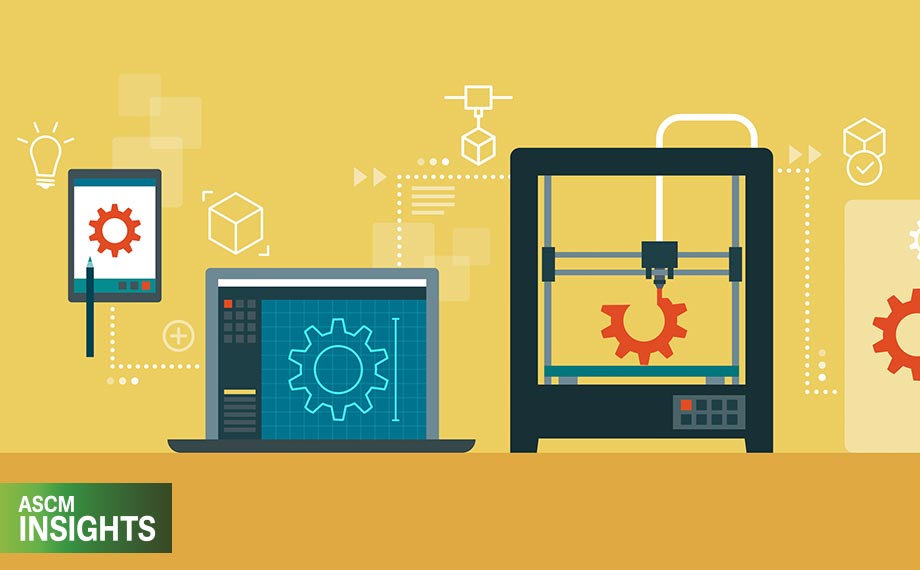
3D printing is instrumental for prototyping, custom tooling, replacement parts, personalized medical devices, small and medium-sized production runs, and many other manufacturing applications. But what's to come in the 3D printing realm, and how will additive manufacturing change supply chains as the technology continues to evolve?
What is 3D printing, and how does it work?
Also known as additive manufacturing, 3D printing is the process of layering materials to make products and components using computer data. Imagine printing spare parts at your distribution center instead of waiting weeks for traditional manufacturing, or creating custom packaging solutions tailored to specific products, all without massive tooling costs. That's the power of 3D printing. It streamlines your supply chain by:
- Reducing dependence on traditional manufacturing: Print parts locally, minimizing lead times and transportation costs.
- Boosting inventory agility: Create custom items on-demand, eliminating the need for large, static inventories.
- Enhancing innovation: Prototype and iterate designs quickly and cheaply, accelerating time-to-market.
- Personalizing offerings: Adapt products to individual customer needs with bespoke printed components.
- Improving sustainability: Minimize waste and optimize material usage through additive manufacturing.

How far 3D printing has come
In recent years, 3D printing has gotten bigger, faster and cheaper. Rising demand for specialized materials to fulfill the required properties of end parts has driven developments in the range and types of options available. The key for the new generation of printers, especially industrial-grade solutions, is the ability to handle a greater range of advanced materials. This has opened the door for businesses to benefit from additive manufacturing in areas where they previously could not.
Although machine costs remain somewhat high, increased printing speed has been pushing down the price. As more and more businesses adopt 3D printing, these advancements will continue to accelerate. And with the addition of processes such as dual extrusion, the versatility of 3D printing will keep growing and be adopted in a wider range of industries.
How 3D printing works
3D printing is part of an integrated supply chain approach. To maximize benefits, manufacturers are using a large range of printers and materials and, importantly, connections with other industry professionals. Furthermore, interoperability among systems has become important to maximize the technology’s potential. Automation in production and post-processing, as well as in integrated usability, were key trends and continue to be.
Additive manufacturing provides a whole new supply chain approach as part of a holistic and secure platform in which the individual steps are combined into one process, from concept to materials, digital inventory, production and delivery. As manufacturers strive toward Industry 5.0, services offering a fully automated, yet secure, platform are essential.
Partnerships have created mutual benefits and synergies that lead to a greater final product for customers. Standards are being developed, and printer and post-processing systems are increasingly able to work together. In addition, shared production data has led to improved printers and materials for all. As always, close collaborations are essential to achieving the best possible solution. An ecosystem where service providers, material producers and print farms are increasingly connected is an important next step.
Quality and cybersecurity assurance are also essential. 3D printing has continued to transform today’s industries, with companies adopting the technology for many of their needs, thereby giving rise to a more integrated production environment. Of course, businesses demand assurance that their 3D printed parts will meet necessary quality requirements. It’s important to carefully select production partners, check their capabilities and ensure repeatable fit-for-purpose parts. Moreover, data ownership plays a crucial role and intellectual property and design data have to stay in the right hands.
The benefits of 3D printing
Additive manufacturing printing boosts supply chain resilience. It’s already being used as a solution to a variety of supply chain disruptions, and its role in solving these problems will continue to advance. For instance, because 3D printing production can be situated closer to the consumer location, manufacturing organizations using this technology have built shorter, stronger and more resilient supply chains. Further, engineers and manufacturers can send a design file to the 3D printer nearest the next step in the supply chain, whether it’s the manufacturer receiving the component or the consumer receiving the final product. This also means there’s less need to store and incrementally move inventory. Instead, parts can be printed and shipped the shortest practical distance, thus reducing carbon dioxide emissions and boosting supply chain resilience.
Indeed, additive manufacturing drives sustainability forward in many ways. By specifically designing a part for 3D printing, engineers have drastically decreased the weight of the end part, therefore reducing the material needed for production. Moreover, when 3D printing is used as part of an on-demand and decentralized digital warehouse, it reduces the number of parts in inventory and the associated waste. Plus, by locating production closer to the next step in the supply chain, carbon dioxide emissions during transport have been reduced. And there has been significant growth in sustainable 3D printing materials such as recycled, reusable and biodegradable plastics.
Predictions for the future of 3D printing
When determining how to prepare your supply chain organization for the future of additive manufacturing, consider the following five predictions about 3D printing's near future:
- Mass customization at scale: 3D printing will move beyond niche personalization to enable true mass customization across a wider range of consumer and industrial products, driven by advancements in printing speed and material handling.
- Embedded intelligence and functionality: Expect a rise in 3D-printed objects with integrated sensors, electronics and even biological components, blurring the lines between manufacturing and advanced technology.
- Decentralized and distributed manufacturing networks: 3D printing will fuel the growth of localized and interconnected micro-factories, further shortening supply chains and enabling greater responsiveness to regional demands.
- Advanced materials science breakthroughs: There will be significant innovations in 3D printing materials, including stronger, lighter, more sustainable and multi-functional materials tailored for all kinds of applications.
- AI-driven design and optimization: AI will play a crucial role in optimizing part design for 3D printing, predicting material performance and automating the entire additive manufacturing workflow.
The future of 3D printing remains bright, promising faster, more diverse and more integrated production methods. By embracing these trends and prioritizing quality, security and sustainability, this technology will continue to revolutionize manufacturing and empower businesses to create a more resilient and responsible future.
Take a deeper dive into this and other technology-related topics with the ASCM Supply Chain Technology Certificate.
Editor’s note: Some of the information in this blog has been updated to reflect current research and insights. The original publication date was August 2022.